
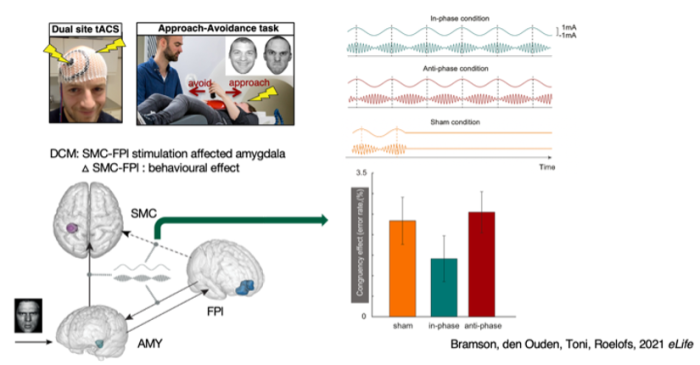
In this project we build on previous work indicating that cross-frequency coupling between the lateral prefrontal cortex (FPl) and somatosensory cortex (SMC) is linked to social emotional action control (Bramson et al., 2018 JoN): in specific, FPl-theta was coupled to SMC-gamma during efficent control on an approach-avoidance task, requiring to override automatic emotional action tendencies. Based on these findings, we moved on to apply dual-site transcranial alternating current stimulation (tACS) to enhance this type of control in neurotypicals (Bramson et al., 2020 – eLife) and found enhanced control expressed by reduced error rates when we stimulated in-phase versus anti-phase or sham. We could replicate this effect in highly anxious (Meijer et al., in revision) and are now applying combined with an intervention for social anxiety disorder, to investigate if dual-site tACS can enhance the efficacy of exposure therapy (Caneiro de Andrade – ongoing study).
Selected publications:
Bramson B, den Ouden HE, Toni I, Roelofs K. (2020). Improving emotional-action control by targeting long-range phase-amplitude neuronal coupling. eLife. 9:e59600. link
Bramson B, Folloni D, Verhagen L, Hartogsveld B, Mars RB, Toni I, Roelofs K. 2020. Human Lateral Frontal Pole Contributes to Control over Emotional Approach-Avoidance Actions. J Neurosci. 40(14):2925-2934. link
Bramson, B., Meijer, S., van Nuland, Toni, I., Roelofs, K (2023). Anxious individuals shift emotion control from lateral frontal pole to dorsolateral prefrontal cortex. Nature Communications 14, 4880. link
Bramson B, Jensen O, Toni I, Roelofs K. (2018). Cortical Oscillatory Mechanisms Supporting the Control of Human Social-Emotional Actions. J Neurosci. 38(25):5739-5749. link