
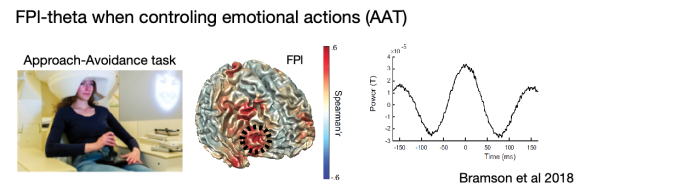
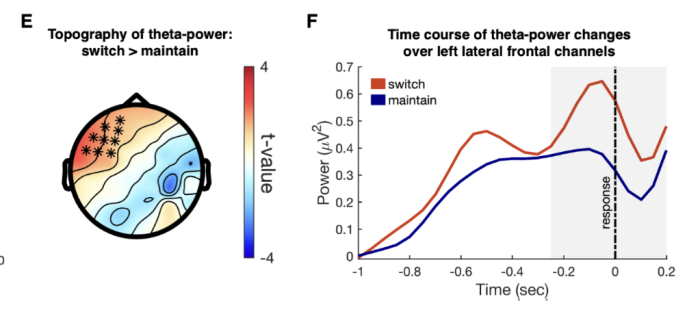
In this project we test the how people are able to adjust emotion regulation strategies to changing situational demands. Using various neuroimaging techniques (fMRI, MEG, TMS) we consistently found that the lateral frontal pole (FPl) is critically involved when one needs to override an automatic emotional action tendency (Roelofs et al., 2009; Bramson et al., 2020; 2023). This is a capacity that we typically asses using an approach-avoidance task (AAT). During the AAT, the FPl communicates with downstream regions including the amygdala and SMC (Volman et al., 2011; Bramson et al., 2020 eLife), particularly using frontal theta (Bramson et al., 2020). Later we observed that the FPl is also involved in more cognitive emotion regulation tasks where one has to chose between strategies such as reappraisal and distraction (Koch et al., 2018). Based on these findings we developed the Flexible Emotion Control Theory, (FECT, Roelofs et al., 2023). Testing the FECT, we recently assessed the role of the lateral frontal pole in flexible emotion control and found that lFP-theta oscilations precede the decision to switch form emotion regulation strategy (Adamczyk et al., 2025).


Selected publications
Roelofs K, Bramson B, Toni I. (2023). A neurocognitive theory of flexible emotion control: The role of the lateral frontal pole in emotion regulation. Ann N Y Acad Sci. 1525(1):28-40. doi: 10.1111/nyas.15003. Epub 2023 May 11. PMID: 37170478.
Adamczyk A, Bramson B, Koch S, Wyczesany, M, van Peer J, Roelofs K. (2025). Lateral frontopolar theta-band activity supports flexible switching between emotion regulation strategies. Sci Rep 15, 10900. https://doi.org/10.1038/s41598-025-91177-8.
Bramson B, Toni I, Roelofs K. Emotion regulation from an action-control perspective. Neurosci Biobehav Rev. 2023 Oct;153:105397. doi:10.1016/j.neubiorev.2023.105397. Epub 2023 Sep 20. PMID: 37739325.
Koch SBJ, Mars RB, Toni I, Roelofs K. (2018). Emotional control, reappraised. Neurosci Biobehav Rev. 95:528-534. doi: 10.1016/j.neubiorev.2018.11.003.
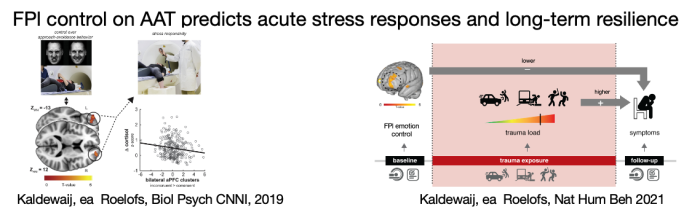
Kaldewaij R, Koch SBJ, Hashemi MM, Zhang W, Klumpers F, Roelofs K. (2021). Anterior prefrontal brain activity during emotion control predicts resilience to post-traumatic stress symptoms. Nat Hum Behav. 5, 1055–1064 doi: 10.1038/s41562-021-01055-2. https://rdcu.be/cwRUs
Kaldewaij R, Koch SBJ, Zhang W, Hashemi MM, Klumpers F, Roelofs K. 2019. Frontal Control Over Automatic Emotional Action Tendencies Predicts Acute Stress Responsivity. Biological Psychiatry CNNI, 4(11):975-983. doi: 10.1016/j.bpsc.2019.06.011.