
It is widely recognized that police performance may be hindered by psychophysiological state changes during acute stress. To address the need for awareness and control of these physiological changes, police academies in many countries have implemented Heart-Rate Variability (HRV) biofeedback training. Despite these trainings now being widely delivered in classroom setups, they typically lack the arousing action context needed for successful transfer to the operational field, where officers must apply learned skills, particularly when stress levels rise. The DUST project aims to address this gap by training physiological control skills in an arousing decision-making context. We developed a Virtual-Reality (VR) closed-loop heart-rate variability biofeedback training in which police officers learn to effectively perform physiological self-regulation an engaging game-like action context.
This project is a collaboration between the EPAN lab and the GemHlab (https://gemhlab.com/) from Radboud University and the Dutch Police.
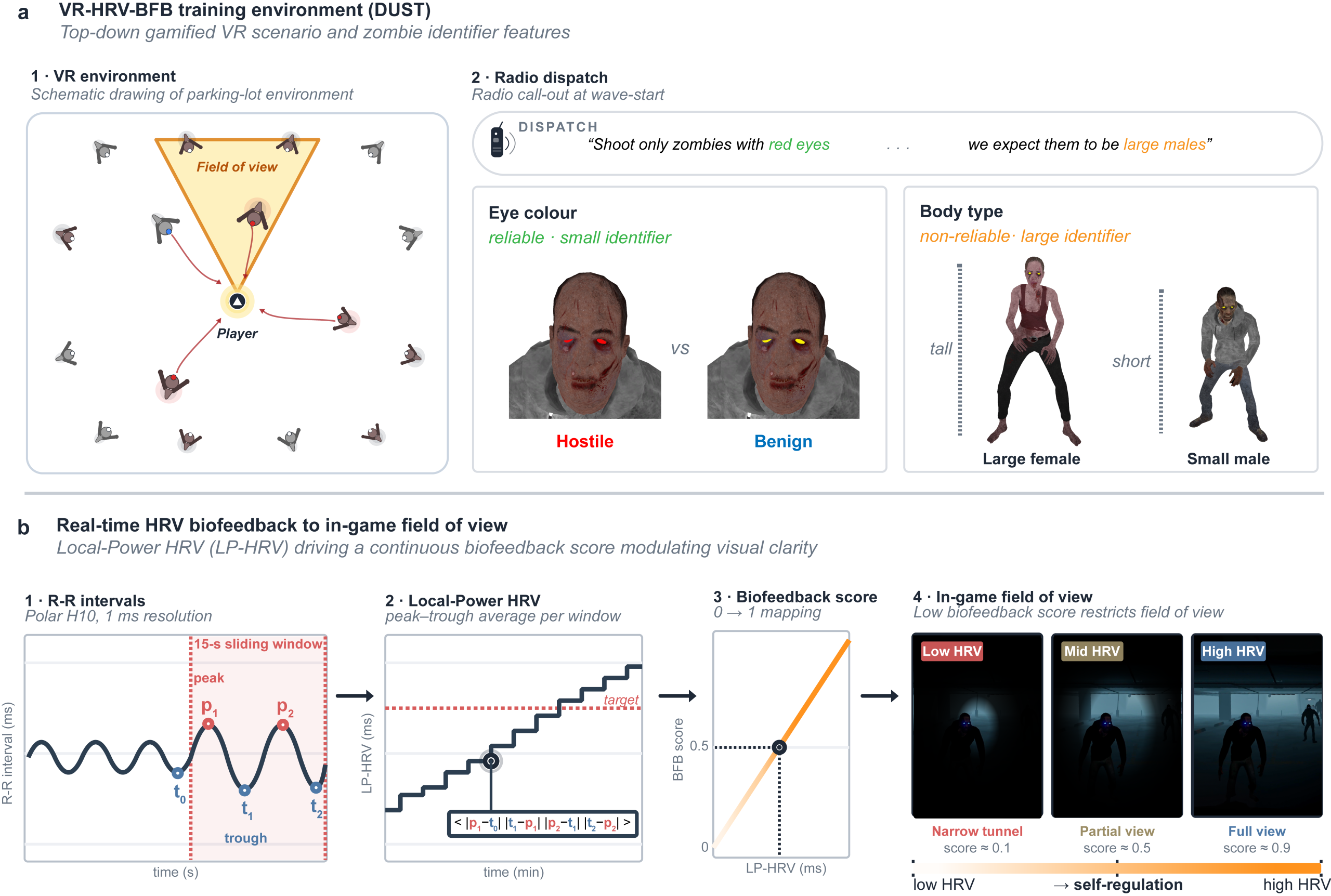
Note. a) The DUST game environment. Players defend a central position in a parking lot against successive waves of zombies approaching from all directions; hostile and benign zombies are signalled via radio dispatch containing two identification cues (eye colour and body type). b) The closed-loop biofeedback pipeline. Inter-beat intervals (IBIs) recorded from a Polar H10 chest strap are processed online; local-power heart rate variability (LP-HRV) is computed as the mean peak-to-trough difference of the IBI series within a 15-s sliding window, updated at every detected peak or trough. LP-HRV is compared to an individually calibrated target to produce a biofeedback score, which modulates the player’s field of view (FOV): higher LP-HRV widens the FOV and improves in-game visibility, lower LP-HRV progressively narrows the FOV until only zombies directly ahead remain visible. FOV modulation was active only during biofeedback playthroughs.
Selected publications
Brammer, J. C., van Peer, J. M., Michela, A., van Rooij, M. M. J. W., Oostenveld, R., Klumpers, F., Dorrestijn, W., Granic, I., & Roelofs, K. (2021). Breathing Biofeedback for Police Officers in a Stressful Virtual Environment: Challenges and Opportunities. Frontiers in Psychology, 12. link
Michela, A., Van Peer, J. M., Brammer, J. C., Nies, A., Van Rooij, M. M. J. W., Oostenveld, R., Dorrestijn, W., Smit, A. S., Roelofs, K., Klumpers, F., & Granic, I. (2022). Deep-Breathing Biofeedback Trainability in a Virtual-Reality Action Game: A Single-Case Design Study With Police Trainers. Frontiers in Psychology, 13, 806163. link
Michela, A., van Peer, J. M., Oostenveld, R., Dorrestijn, W., Smit, A. S., Granic, I., Roelofs, K., & Klumpers, F. (2025). Preparing the Heart for Duty: Virtual Reality Biofeedback in an Arousing Action Game Improves in-action Voluntary Heart Rate Variability Control in Experienced Police. IEEE Transactions on Affective Computing, 1–12. link
Michela, A., van Rooij, M. M. J. W., Klumpers, F., van Peer, J. M., Roelofs, K., & Granic, I. (2019). Reducing the Noise of Reality. Psychological Inquiry, 30(4), 203–210. link
Posthuma, J.F, van Peer, J. M., Michela, A., Oostenveld, R., Carneiro de Andrade, M., Brendler A., Roelofs, K., & Klumpers, F. (in prep)
Game design: Koontz interactives https://www.kenkoontz.com/